Home » News » Aggregation and Glial Response Laboratory Receives International Parkinson’s Foundation Impact Award to Investigate New Therapeutic Approach for Parkinson’s Disease
Aggregation and Glial Response Laboratory Receives International Parkinson’s Foundation Impact Award to Investigate New Therapeutic Approach for Parkinson’s Disease
15Oct2026
The Laboratory of Aggregation and Glial Response at ACHUCARRO has been awarded a research grant from the Parkinson’s Foundation to investigate a new approach to understanding and potentially restoring brain function affected by Parkinson’s disease.
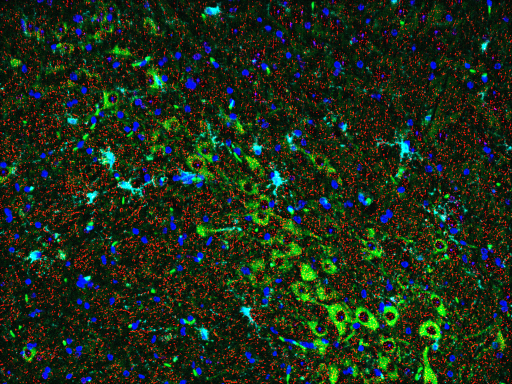
Picture: OPCs (cyan) interact with alpha-synuclein deposits (red) and dopaminergic neurons (green) in Parkinson’s
The project is one of just 12 research projects supported by the Parkinson’s Foundation worldwide through the Impact Award program, highlighting the international scope and significance of the research.
Led by Dr. Bengoa-Vergniory, the team will study a population of brain cells known as oligodendrocyte progenitor cells (OPCs). These cells are involved in maintaining and repairing the brain’s white matter and can change their behavior in response to disease or injury.
While much Parkinson’s research has focused on the loss of dopamine-producing neurons, growing evidence suggests that other types of brain cells may also contribute to changes in brain function. The researchers will investigate whether OPCs play a role in these processes and whether modulating or inhibiting specific OPC-related mechanisms could help restore disrupted brain function in Parkinson’s disease.
“This grant gives us the opportunity to investigate a relatively unexplored aspect of Parkinson’s disease,” said Dr. Bengoa-Vergniory. “Our goal is to understand how oligodendrocyte progenitor cells contribute to the changes that occur in the Parkinson’s brain, and whether targeting these cells or their activity could ultimately help restore function.”
Parkinson’s disease is a progressive neurological disorder that affects movement as well as a wide range of non-motor functions. Despite major advances in understanding the disease, current treatments primarily manage symptoms and do not restore the underlying neural systems that have been affected.
By exploring the role of cells beyond the traditionally studied dopamine-producing neurons, the Laboratory of Aggregation and Glial Response hopes to contribute to a broader understanding of Parkinson’s disease and identify new possibilities for restoring brain function.
We wish to thank the Parkinson’s Foundation for making this research possible. We also wish to thank Diabla Teatro, Helios, SILSON and the many individual donors for their invaluable support in generating the preliminary data for this research.