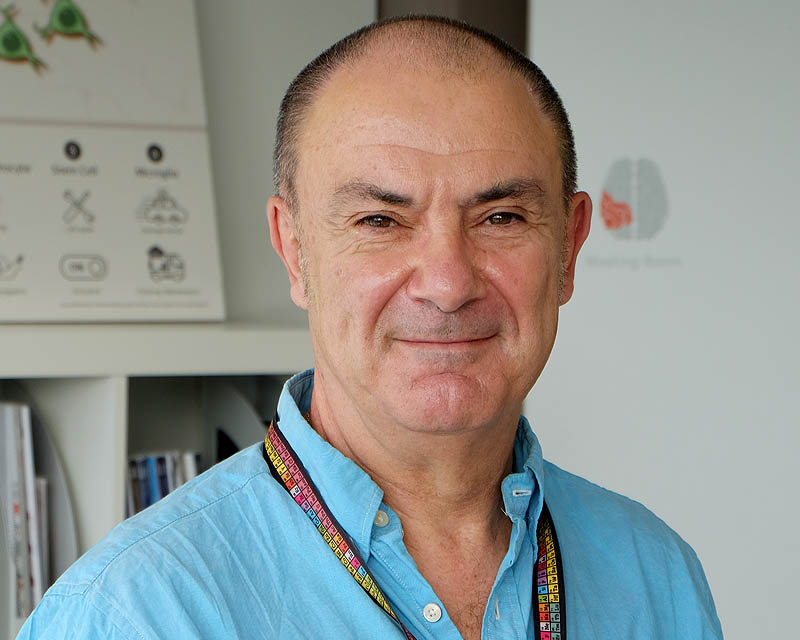
Dr. José Luis Zugaza has been an Ikerbasque Research Professor since 2011 at the Department of Genetics, Physical Anthropology, and Animal Physiology of the University of the Basque Country (EHU), and Principal Investigator at the Achucarro Basque Center for Neuroscience, where he leads the Laboratory of Small GTPases and Neurosignaling. He holds degrees in Biology and Pharmacy, as well as a PhD in Pharmacy, and his international career began as a fellow at the International Agency for Research on Cancer (WHO) while working at the Imperial Cancer Research Fund in London. He later joined INSERM at Université Paris-Saclay, focusing on Rho family GTPases in lymphocyte activation, before moving to the Cancer Research Center in Salamanca as a Ramón y Cajal Fellow. In 2004, he established his own group at CICbioGUNE, where he investigated Rho GTPase-mediated signaling in T cell proliferation and initiated a new line of research on β-amyloid peptide signaling. Between 2008 and 2010, he served as Deputy Director of the Andalusian Initiative for Advanced Therapies, contributing to strategic planning, translational projects, and preclinical trials in advanced therapy medicines.
Throughout his career, Dr. Zugaza has made seminal contributions to the understanding of cellular signaling mechanisms, particularly involving Protein Kinase D (PKD), Rho GTPases, and β-amyloid pathways, with direct implications for neurodegeneration, aging, and rare metabolic diseases. His research on amyloid β oligomer-induced calcium dysregulation and neuronal death (Maillet et al., Nature Cell Biology, 2003; Alberdi et al., Cell Calcium, 2010; Manterola et al., Translational Psychiatry, 2013; Ortiz-Sanz et al., 2019) provided fundamental insights into synaptic dysfunction and neurotoxicity. He has also advanced the field of aging through proteomic analyses of healthy centenarians, identifying molecular pathways associated with successful aging (Santos-Lozano et al., Aging, 2020). In parallel, his studies on PYGM mutations and McArdle disease (Arrizabalaga et al., J. Biol. Chem., 2012; Llavero et al., Cell Signal, 2016; Llavero et al., Small GTPases, 2019; Fiuza-Luces et al., J. Physiol., 2018; García-Consuegra et al., Int. J. Mol. Sci., 2022) have uncovered signaling defects and identified muscle biomarkers that are reshaping diagnostic and therapeutic approaches.
Beyond his scientific publications, he has supervised several PhD dissertations, holds patents related to Alzheimer’s therapies, and founded THREE R Labs, a biotechnology company dedicated to drug screening and the development of Interfering Recombinant Peptides (IRPs). His career exemplifies the integration of fundamental cell signaling research with translational innovation, advancing therapeutic strategies for neurodegeneration, aging, and metabolic disorders.