
Human astrocytes carrying APOE3 or APOE4 variants have distinct effects on Alzheimer’s disease pathology
Researchers from the Laboratory of Humanized Models of Disease, led by Ikerbasque Research professor Amaia Arranz, have published a new article in Cell Reports entitled “APOE3 and APOE4 human astrocytes differentially modulate Alzheimer’s disease pathology and microglial responses in chimeric mice”
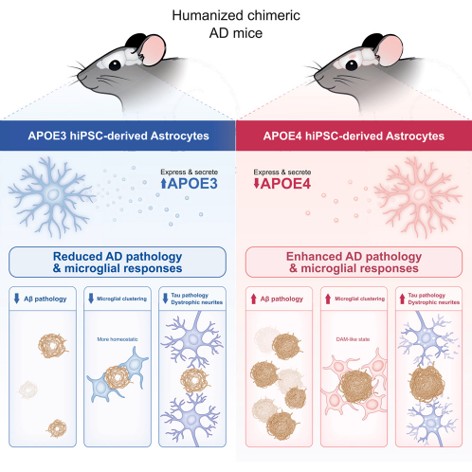
The study investigated how human astrocytes carrying different variants of APOE, the strongest genetic risk factor for sporadic Alzheimer’s disease (AD), influence the development of key pathological features of the disease.
To address this question directly in human cells within the living brain, the researchers developed humanized chimeric models of Alzheimer’s disease. Astrocyte progenitors derived from human induced pluripotent stem cells (hiPSCs) carrying either APOE3 or APOE4 were transplanted into the brains of neonatal AD mice. The human cells matured into astrocytes, integrated into the mouse brain and interacted with the surrounding host cells, providing a unique model to investigate how human astrocytes contribute to AD pathology in vivo.
The results revealed markedly different effects depending on the APOE variant. APOE3 human astrocytes had a protective effect, reducing amyloid-beta pathology, Tau-associated pathology and neuronal damage, whereas APOE4 human astrocytes promoted a more detrimental environment and exacerbated several pathological features of the disease.
Importantly, the effects of the human astrocytes extended beyond their direct impact on Alzheimer’s pathology. The researchers found that they also influenced the response of microglia, the brain’s resident immune cells, to amyloid plaques. APOE4 human astrocytes promoted microglial accumulation around plaques and a more disease-associated state, whereas APOE3 human astrocytes were associated with reduced microglial clustering and a more homeostatic profile.
Together, these findings demonstrate that human astrocytes can actively shape Alzheimer’s disease pathology in an APOE-dependent manner, influencing not only amyloid and Tau pathology and neuronal damage, but also the behavior of other cells in the brain. The work also illustrates the potential of humanized chimeric models to bridge the gap between conventional animal models and human disease, allowing researchers to investigate the specific contribution of human brain cells to neurodegenerative processes in vivo.
The study was led by researchers at ACHUCARRO and the University of the Basque Country (EHU), in collaboration with national and international research groups.
Congratulations to all authors and collaborators on this achievement!
Read the full article: https://doi.org/10.1016/j.celrep.2026.117803