Home » News » How the timing of brain development shapes the human brain
How the timing of brain development shapes the human brain
04Feb2026
Researchers from the Biobizkaia Health Research Institute, along with Ikerbasque researchers, have identified fundamental rules linking embryonic brain development to the way the adult human brain is structurally and functionally organized.
The study, published in Nature Communications, reveals that when brain circuits are generated during development strongly determines their later importance in brain networks.
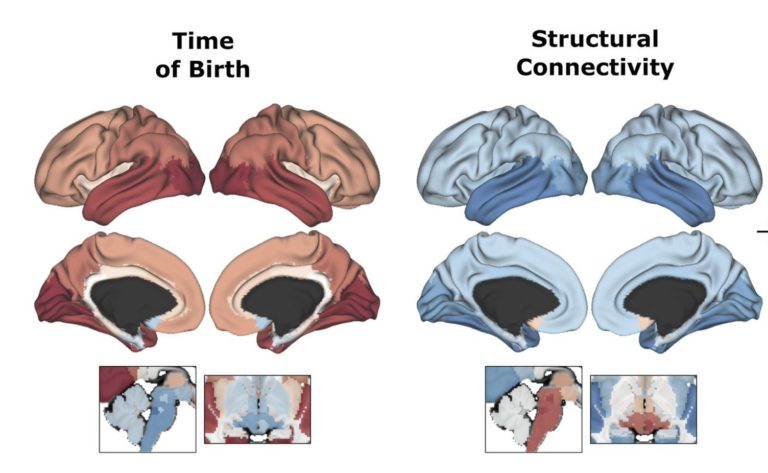
Regions of the human brain that are generated earlier in development (blue in the graph on the right, are those that have the greatest structural connectivity (in red, graph on the right).
The international team, led by the Computational Neuroimaging Laboratory at Biobizkaia, Prof. Paolo Bonifazi, Dr. Ibai Diez and Prof. Jesús Cortés, in collaboration with Ikerbasque researchers Prof. Fernando García-Moreno from ACHUCARRO and Mauro D’Amato, presents a new framework to understand large-scale brain organization from a developmental perspective.
The researchers show that brain regions and circuits that form earlier during embryonic development tend to become the most influential hubs in the adult brain. These early-born circuits establish more numerous and longer-range connections, giving them a central role in coordinating brain activity. In contrast, circuits generated later show a different balance between structural and functional importance.
The study identifies two simple principles governing this process. First, an “older gets richer” rule, whereby earlier-developed circuits acquire greater structural influence over time. Second, a “preferential age attachment” rule, meaning that brain regions formed at similar developmental stages are more likely to connect with each other.
By integrating brain imaging, developmental neurobiology and large-scale gene expression data, the researchers demonstrate that these organizational principles are closely linked to genetic programs active during early neurodevelopment. This reveals how the adult brain’s architecture reflects its embryonic history.
Although the study focuses on fundamental brain organization, the findings also help explain why disruptions to early-developed brain hubs can have widespread consequences, providing insight into vulnerability patterns observed in several neurological disorders.
Overall, this work highlights the importance of developmental timing as a key factor shaping the human brain and reinforces the role of Biobizkaia and Ikerbasque as leading institutions in network neuroscience and human connectomics.