
Three Achucarro researchers and a former predoctoral researcher to present their work at the 2nd Iberian Glia Symposium
Three researchers from ACHUCARRO, Nuria Galbis Gramage, Uxue Balantzategi Fernandez de Arroiabe and Marina Bosch Juan, and former predoctoral researcher, Carla Peiró-Moreno, will participate in the 2nd Iberian Glia Symposium, taking place online on 25 and 26 November 2026. Organised by Rede Glial Portuguesa and Red Glial Española, the meeting will bring together researchers from the Iberian glial research community to share scientific advances, present ongoing research and foster scientific exchange and collaboration.
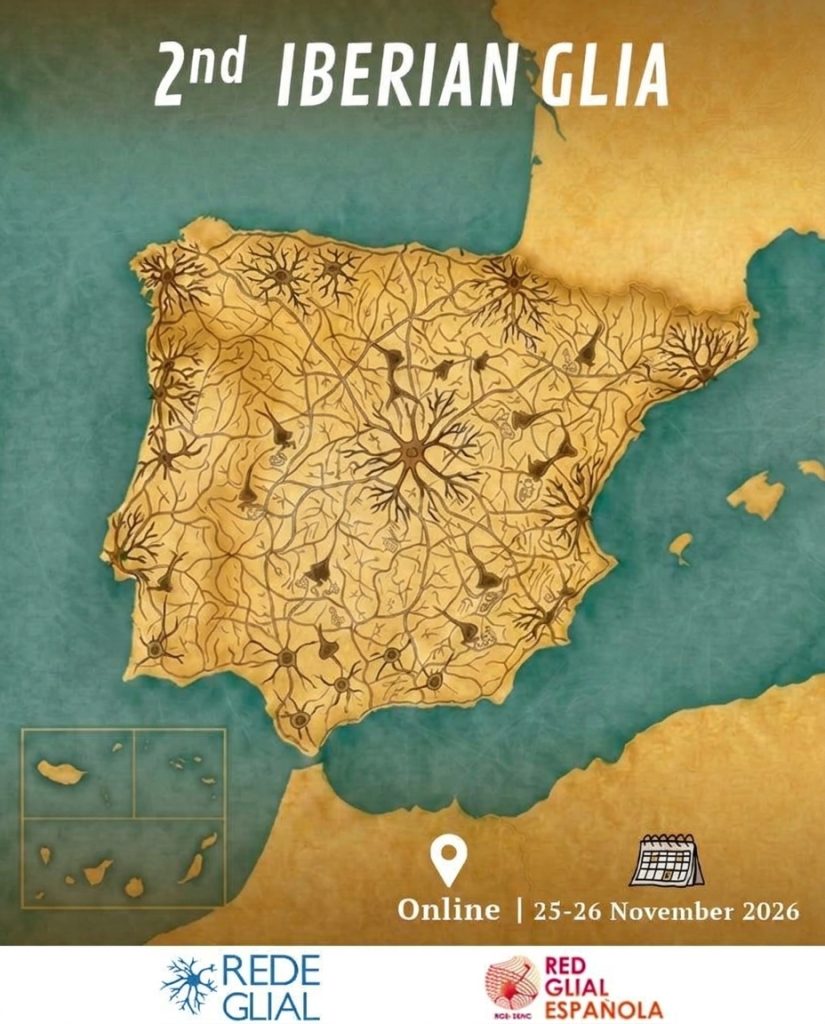
Carla Peiró-Moreno, Nuria Galbis Gramage, Uxue Balantzategi Fernandez de Arroiabe and Marina Bosch Juan will each deliver an oral presentation as part of the scientific programme. Their contributions will address different aspects of oligodendrocyte and myelin biology and their involvement in neurological disorders.
Four talks on glial research
On the first day of the symposium, 25 November, Carla Peiró-Moreno, who completed her predoctoral research at the Laboratory of Glia and Matrix Biology and is currently a postdoctoral researcher at the University of Edinburgh (Edinburgh, Scotland), will present “Internalization of exogenous myelin by oligodendroglia promotes lineage progression”. Her research explores how myelin debris, traditionally considered an obstacle to repair, can instead promote oligodendrocyte development. She will show that oligodendrocytes internalise exogenous myelin, store it in lipid droplets and reduce their own cholesterol and fatty acid synthesis. This process promotes their proliferation and further maturation, an effect observed in primary cultures, mouse cortex and zebrafish spinal cord. Her findings suggest that, in the absence of pathological cues, myelin debris can act as a trophic signal supporting oligodendroglial self-renewal.
Next, also on 25 November, Nuria Galbis Gramage, postdoctoral researcher at the Laboratory of Glia and Matrix Biology and the Laboratory of Humanized Models of Disease, will present “Apoe4 human oligodendrocytes generate altered myelin and impair axon-myelin organization in chimeric mice”. Her work uses human stem cell-derived oligodendrocytes transplanted into Shiverer mice to establish an in vivo model for studying human oligodendrocytes and myelin, as well as the effects of the APOE genotype on these cells. The researchers found that the human cells integrate into the mouse brain and myelinate axons. They also observed that oligodendrocytes carrying the APOE4/4 genotype showed reduced myelin formation and altered development of the nodes of Ranvier.
On the second day, 26 November, Uxue Balantzategi Fernandez de Arroiabe, postdoctoral researcher at the Laboratory of Glia and Matrix Biology, will present “Impaired MYRF degradation links amyloid-β to oligodendrocyte and myelin dysfunction in Alzheimer’s disease”. Her research investigates the deregulation of MYRF, a transcription factor essential for oligodendrocyte maturation and myelin maintenance, in Alzheimer’s disease. By analysing human brain samples and transcriptomic data, alongside studies in mouse models and primary oligodendrocyte cultures, the researchers found that amyloid-β promotes MYRF accumulation by extending its half-life through a PKC-dependent pathway. Sustained MYRF accumulation compromises oligodendrocyte viability. In 3xTg-AD mice, pharmacological inhibition of PKC reduced MYRF accumulation, restored oligodendrocyte populations and normalised myelin parameters. It also improved learning and spatial memory in the mice, supporting further investigation of this pathway as a potential therapeutic target in Alzheimer’s disease.
Also on 26 November, Marina Bosch Juan, predoctoral researcher at the Laboratory of Glia and Matrix Biology, will present “Oligodendrocyte GPCR signaling sustains axons via the lactate shuttle in Multiple Sclerosis model”. Her research investigates how mature oligodendrocytes help maintain axonal integrity through metabolic support in an animal model of multiple sclerosis. Using chemogenetic approaches, the researchers showed that activating these cells increases glycolysis and metabolic coupling with axons, supporting energy supply and axonal survival in experimental autoimmune encephalomyelitis. Building on this finding, the team is screening G protein-coupled receptors (GPCRs) in both mouse and human models to identify those capable of reproducing this metabolic coupling, with the aim of developing strategies to prevent axonal damage.
The participation of these four researchers highlights ACHUCARRO’s research activity in glial biology, particularly in understanding how oligodendrocytes and myelin contribute to nervous system function and how they are affected in neurological diseases.
More information: 2nd Iberian Glia Symposium